

Hermes Sandals Size Guide: Fit and Sizing Tips
Get a no-nonsense roadmap to sizing Hermes sandals so the shoes fit like they were made for your feet. This guide covers measurement, model differences, conversion, common mistakes, and practical fixes so you can order with confidence.
Hermes sandals are an investment in comfort and style; getting the right size avoids returns and uncomfortable wear. The brand’s mix of leather, molded footbeds, and different sole constructions means fit varies by model and material. This article focuses on measurable steps: how to measure, how to interpret Hermes sizing, what to expect from leather versus rubber, and precise fit checks you can use at home. Read on for tailored advice for Oran, Izmir, Oasis and other popular Hermes sandals.
This guide is aimed at people who research before buying, shoppers dealing with international size conversions, and anyone with narrow, average, or wide feet who wants reliable fit strategies. It assumes access to a ruler or tape, a normal sock for measurement, and the ability to try a single pair in a store or order from a reputable retailer with a clear return policy. Expect plain-language, experience-driven recommendations rather than marketing claims.
How do Hermes sandals generally fit?
Hermes sandals typically run true to European sizing but vary by model; leather straps can feel snug at first and loosen with light wear, while molded footbeds and sportier designs feel more stable out of the box. Expect narrow-to-medium width across most leather styles and slightly generous fit in rubber or contoured models.
Leather Hermes sandals usually have a firm, structured strap and a stiffer footbed on first wear. That structured feel is intentional: leather stretches across the forefoot and strap area over days, not weeks, and will give a few millimeters to a centimeter depending on leather type. Models with a molded or contoured footbed provide a predictable length and arch support, so if the toe sits just behind the edge and the heel doesn’t slip, length is correct. Rubber or EVA-based sandals often run roomier and won’t stretch, so they rely entirely on accurate sizing from the start. Keep in mind that narrow and high-arched feet need different adjustments than flat or wide feet; Hermes does not usually offer multiple width fittings within the same size number.
Common signals of a correct fit include even pressure across the strap, the toe not hanging over the edge, and the heel remaining seated without severe slippage. If the strap digs into the top of the foot after short wear, it’s likely too small; if the foot slides forward by more than 5 millimeters with a normal step, the sandal is too large. These practical checks are more reliable than brand claims of \”true to size.\”
How should you measure your foot for accurate Hermes sizing?
Measure standing, at the end of the day, with the sock thickness you plan to wear; use the longest foot length in centimeters to pick the EU size that matches or allows 0.5–1 cm clearance. Conversions to US/UK sizes are approximate—use centimeters as the primary guide.
Stand on a sheet of paper with your full weight on the foot, trace the perimeter, mark the longest toe and the back of the heel, then measure the straight-line distance between those two points. Do this for both feet and use the longer measurement; feet are rarely perfectly symmetrical. Record the length in centimeters and compare it to the conversion table below to identify the nearest EU size. If your measurement falls exactly between two sizes, consider foot width and the specific Hermes model: choose the larger size for narrow-but-long feet only if straps are adjustable or the model has roomier footbeds; otherwise size up to avoid toe overhang.
Also measure across the ball of the foot (widest point) to understand forefoot width; Hermes straps that cross the forefoot can feel tighter for wider feet even if length is correct. If your ball width exceeds average values for your length, expect to size up or seek styles with open straps or adjustable designs. Time-of-day measurement matters because feet expand; the end-of-day measurement is your safest baseline.
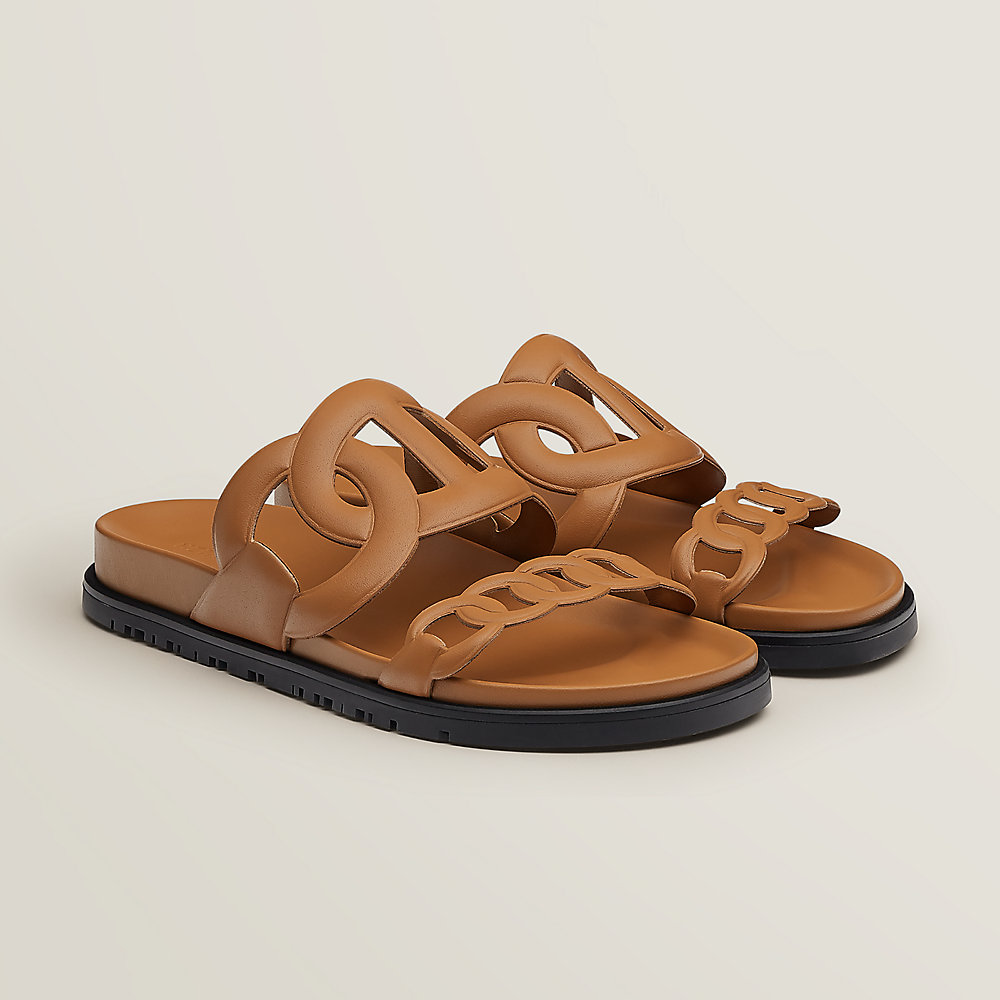
Hermes size conversion chart
Use the centimeter measurement as the authoritative metric, then confirm with EU sizing; US and UK sizes are included for reference. Always round to the nearest whole EU size and favor the larger size when between increments.
| EU | US (Women) | UK | Foot length (cm) |
|---|---|---|---|
| 35 | 5 | 3 | 22.8 |
| 36 | 6 | 4 | 23.5 |
| 37 | 6.5–7 | 4.5–5 | 24.1 |
| 38 | 7.5–8 | 5.5–6 | 24.8 |
| 39 | 8.5–9 | 6.5–7 | 25.5 |
| 40 | 9.5–10 | 7.5–8 | 26.1 |
| 41 | 10.5–11 | 8.5–9 | 26.8 |
| 42 | 11.5–12 | 9.5–10 | 27.5 |
Remember: Hermes lists products by EU size on most sites. If a retailer shows only US sizing, reverse-check centimeters; sizing mistakes happen when shoppers rely only on US/UK conversions. This table is a practical conversion tool—treat the centimeter column as decisive.
Model-specific fit: Oran, Izmir, Oasis — what differs?
Oran sandals are leather, structured, and often feel snug across the instep initially; Izmir is sportier with molded footbeds that sit truer to measured length; Oasis and other two-strap styles offer more forefoot room but depend on strap placement. Knowing model tendencies helps you choose one size up or stick with true EU sizing.
Oran: The classic Oran has a single H-shaped leather strap and a thin leather or trimmed sole; the strap sits across the forefoot and can feel tight on wide feet. Leather will stretch slightly, so if your measurement is borderline you can often stay with your usual EU size, provided the toes do not hang over the sole edge. For very wide feet, size up by one EU to reduce pressure on the top of the foot.
Izmir: The Izmir model commonly uses more flexible, sportier materials and sometimes features a molded footbed. Because materials don’t stretch much, select the size that matches your centimeter measurement precisely; avoid relying on leather give. Izmir often feels more secure for walking longer distances because of its footbed shape.
Oasis and double-strap styles: These can be more forgiving across the forefoot because strap placement distributes pressure differently. If straps are adjustable or the footbed is slightly wider, stick to your measured EU size. For designs with backstraps, pay attention to heel seating: a loose backstrap means a larger size is needed to prevent slippage.
Material note: Smooth calfskin softens over wear and gains width; grained leathers are slightly stiffer. Rubber and EVA components won’t change, so accuracy on first order matters. Consider model construction first, then length and width second.
Should you size up, down, or stick with your usual size?
If you have average-width feet and use centimeter measurement, choose the matching EU size; size up when feet are wide, when the strap sits across the widest point, or when the model has rigid leather that won’t stretch enough for comfort. Avoid sizing down unless you routinely find all brands oversized.
Sizing rules will vary with personal foot shape and the specific Hermes model. For narrow feet, sticking with measured EU size generally gives the best heel hold without slippage. For wide feet, upsize by one EU if straps cross the ball of the foot and cause pressure; the extra width will usually eliminate painful hotspots. Half-size dilemmas are common because Hermes sizes in whole EU increments; if you’re between EU sizes and prefer a snug, polished look, order the smaller size only if the model uses stretch-friendly leather.
Pay attention to toe position: the longest toe should sit approximately 3–5 millimeters from the front edge of the sole for sandals with little sole flex; for flexible molded footbeds, aim for a hairline clearance. Heel slip should be minimal—around 3–5 millimeters is acceptable at first wear. If heel lift is larger, the sandal is too big and will cause blisters. When ordering online, confirm the seller’s return policy and measure twice; returns are less fun with luxury footwear but necessary when fit uncertainty is high.
Common fit mistakes and how to avoid them
Buying purely on your usual US size, measuring sitting down, and measuring in the morning are three frequent errors that lead to poor fit; always measure standing, at the end of the day, and compare centimeters to an EU chart. Also, ignoring forefoot width and strap placement is a major oversight with Hermes leather sandals.
Another mistake is expecting dramatic leather stretch. Leather will soften and give a little, but it won’t create extra length; pressing a tight toe beyond comfort in hopes of stretch risks irreversible damage. Ordering based on a single foot measurement without checking the other foot is risky because the longer foot dictates sizing. People often assume that a thicker insole or sock will solve slippage; this can create pressure points and ruin the intended fit.
Expert Tip: \”Don’t size up to compensate for narrow straps unless the strap crosses the forefoot; instead, try a model with a more open strap or ask a cobbler to add a dedicated thin leather heel pad—this stops heel slip without changing length.\” This tip prevents the common error of buying a larger size that then causes heel lift and toe overhang.
Care, adjustments, and little-known fit facts
Proper care and minor adjustments can rescue a close-fitting pair; leather conditioners soften straps slightly, while a professional cobbler can lightly stretch leather or add heel pads to improve fit. Small changes often make the difference between an uncomfortable pair and an everyday favorite.
If the straps are tight across the top, use a leather conditioner sparingly and wear the sandals around the house with thick socks for short sessions to accelerate gentle stretching; avoid heat guns or extreme methods that deform leather. For heel slippage, thin stick-on heel grips or a leather cobbler’s pad restore seating without adding bulk across the toe. Insoles designed for hermes oran sandals that sit shallow can raise the heel enough to eliminate slip but choose low-profile options so the straps aren’t strained. For mismatched fit between two feet, select the size matching the longer foot and use a thin insole on the shorter foot; this is a standard cobbler solution.
Little-known facts: Hermes often uses different factories and leathers across models so two sandals from the same season can feel different; leather from lambskin stretches more than box calf; some Hermes styles use a stacked leather midsole under a rubber outsole which changes perceived cushioning; contoured footbeds distribute pressure differently than flat leather soles; custom stretching by a specialist cobbler can adjust strap tension without changing length. These details shape real-world fit and are worth knowing before deciding on a size.
When you combine precise measurement, model knowledge, and small post-purchase adjustments, you can achieve the comfort and look Hermes intends without compromise. Use the centimeter measurement as your anchor, respect model-specific tendencies, and apply simple fixes rather than guessing at size changes.